Why We See the Same Code Differently
•Alexander Bridgwater
Loading...
Close your eyes. Try to visualize the largest, most complex repository you’ve ever worked on.
It’s difficult, isn’t it? You might see a flash of a specific directory, a gnarly dependency graph, or perhaps just that one legacy module everyone is afraid to touch. The sheer scale makes it impossible to hold the entire structure in your head at once.
But here is the fascinating part: If you ask three different people in your organization to describe that exact same codebase, you won’t just get three different descriptions. You will get three entirely different realities.
We don't memorize code; we build mental maps. We structure knowledge around the specific "altitude" we fly at. A backend developer needs the granular details of file architecture to do their job, whereas a stakeholder needs the high-level view of data flow.
But when those maps don't align, collaboration breaks down.
In cinema, the "Rashomon Effect" occurs when different witnesses describe the same event in contradictory ways. In software, we build internal maps based on our function.
While there are many nuances (and technical CEOs who love looking at raw SQL), we generally see three broad archetypes:
payment_controller.rb; they see the "Checkout Flow" or the "Subscription Upgrade Logic."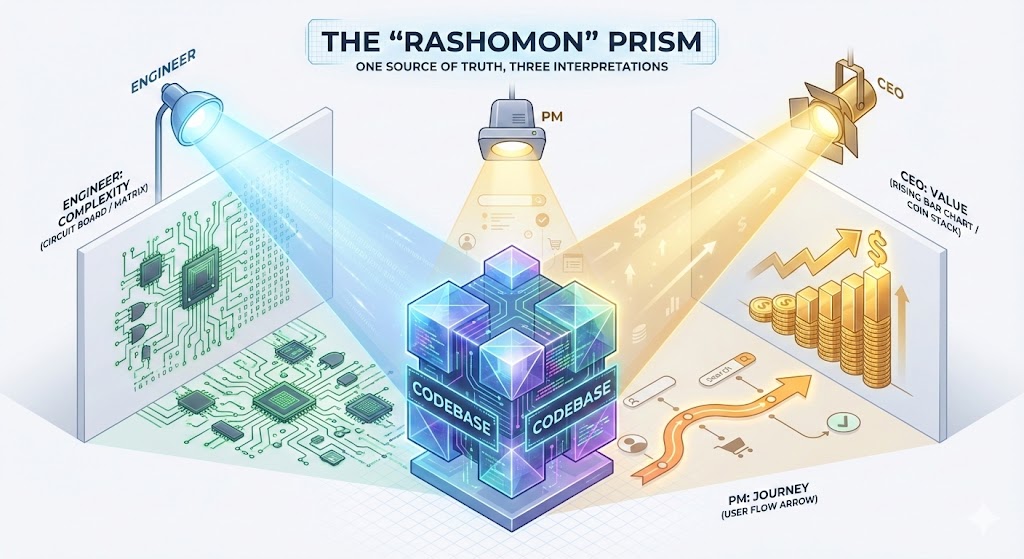
They all are.
There is no "wrong" way to visualize a repository. However, these disjointed perspectives create a massive hidden cost in every organization: The Translation Tax.
When a PM asks, "Why is the checkout flow broken?", and the Engineer answers, "Because the API gateway is timing out due to a circular dependency in the User model," they are speaking different languages. They are pointing at the same building but describing different floors.
This misalignment leads to:
CodeBoarding eliminates the "Translation Tax" by creating a single source of truth that speaks everyone's language. We are building a "Control Plane" that connects raw code to the management tools your team already uses, like Linear, Jira, Slack, and GitHub.
Instead of forcing a single worldview, we enable Multi-Persona Workflows:
Join the Pilot We are currently launching formal pilots with mid-market and enterprise companies to prove this value. If your organization creates complex software and feels the pain of misalignment, we want to hear from you.